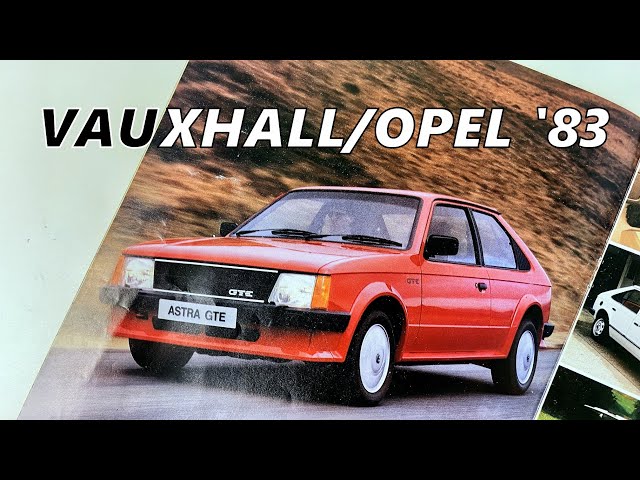
Are you looking for the entire list of Opel Vauxhall cars – you have found it!
Here is your list, names of cars and the year of manufacture.
If you don’t see the make or model you are looking for, then simply pop a message to us, and we will research it and add it to the list for you.
Complete Opel and Vauxhall Vehicle History Guide (1899–2022)
This comprehensive Opel and Vauxhall vehicle history guide covers the most important models produced throughout more than a century of automotive innovation. Whether you are researching classic Opel cars, historic Vauxhall models, German automotive heritage, or collectible European vehicles, this timeline highlights key specifications, historical significance, and fascinating facts about each model.
1899 Opel Patentmotorwagen
The Opel Patentmotorwagen marked Opel’s transition from bicycle manufacturing into automobile production. It was one of the earliest production cars built in Germany and laid the foundation for Opel’s future success.
Specifications
- Production Start: 1899
- Engine: Single-cylinder petrol engine
- Power: Approximately 3.5 hp
- Top Speed: Around 12 mph (20 km/h)
Interesting Facts
- Opel entered automobile manufacturing after acquiring the Lutzmann Motorwagen factory.
- One of Germany’s earliest commercially produced automobiles.
- Represents the birth of the Opel automotive brand.
1909 Opel 4/8 PS “Doctorwagen”
Nicknamed the “Doctor’s Car,” the Opel 4/8 PS became a symbol of professional success and mobility.
Specifications
- Engine: 1.0-litre four-cylinder
- Power: 8 hp
- Seating: Four passengers
- Body Style: Touring car
Interesting Facts
- Popular among doctors due to its reliability.
- One of Opel’s first mass-market success stories.
- Helped make personal transportation accessible to professionals.
1924 Opel Laubfrosch
The Opel Laubfrosch (“Tree Frog”) revolutionised German car manufacturing with assembly-line production.
Specifications
- Engine: 951cc four-cylinder
- Power: 12 hp
- Top Speed: 37 mph (60 km/h)
Interesting Facts
- Germany’s first mass-produced car.
- Famous for its bright green paintwork.
- Significantly reduced vehicle production costs.
1935 Opel Olympia
The Opel Olympia introduced modern all-steel monocoque construction to European motoring.
Specifications
- Engine: 1.3-litre four-cylinder
- Power: 24 hp
- Top Speed: 59 mph (95 km/h)
Interesting Facts
- Named after the 1936 Olympic Games.
- One of Europe’s first mass-produced unitary-construction vehicles.
- Improved safety and reduced weight.
1936 Opel Kadett
The original Opel Kadett established Opel as a major manufacturer of affordable family cars.
Specifications
- Engine: 1.1-litre four-cylinder
- Power: 23 hp
- Body Styles: Saloon and convertible
Interesting Facts
- Inspired future generations of compact Opel vehicles.
- Became the predecessor to the modern Astra.
1937 Opel Admiral
The Admiral served as Opel’s luxury flagship before World War II.
Specifications
- Engine: 3.6-litre six-cylinder
- Power: 75 hp
- Top Speed: 82 mph (132 km/h)
Interesting Facts
- Competed against luxury German brands of the era.
- Known for spacious interiors and elegant styling.
1937 Opel Super 6
A refined executive car offering smooth six-cylinder performance.
Specifications
- Engine: 2.5-litre six-cylinder
- Power: 55 hp
- Transmission: 3-speed manual
Interesting Facts
- Popular among business executives.
- Combined luxury with affordability.
1950 Opel Olympia Rekord
The Olympia Rekord helped rebuild Opel’s reputation after World War II.
Specifications
- Engine: 1.5-litre petrol
- Power: 40 hp
- Body Styles: Saloon, estate
Interesting Facts
- Featured American-inspired styling.
- Became one of Germany’s best-selling family cars.
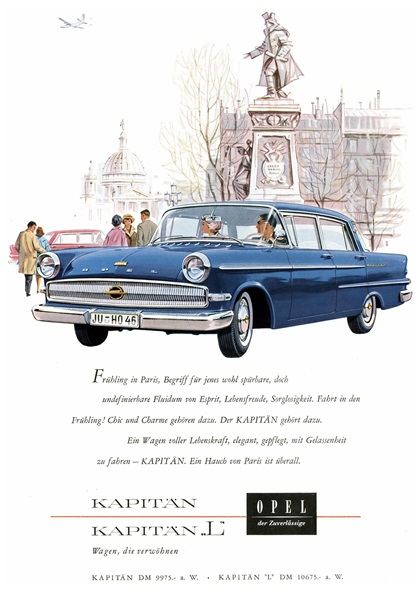
1953 Opel Kapitän
The Kapitän represented luxury and prestige in post-war Germany.
Specifications
- Engine: 2.5-litre six-cylinder
- Power: 68 hp
- Top Speed: 79 mph (127 km/h)
Interesting Facts
- Favoured by government officials and executives.
- One of Opel’s longest-running nameplates.
1962 Opel Kadett A
The Kadett A relaunched the Kadett name and became a huge commercial success.
Specifications
- Engine Range: 993cc–1.0 litre
- Power: 40–48 hp
- Body Styles: Saloon, coupe, estate
Interesting Facts
- More than 600,000 units sold.
- Competed directly with the Volkswagen Beetle.
1963 Opel Rekord
The Rekord became one of Opel’s most successful executive family cars.
Specifications
- Engine Range: 1.5–2.2 litres
- Power: 55–115 hp
- Body Styles: Saloon, estate, coupe
Interesting Facts
- Millions sold across multiple generations.
- Strong export success throughout Europe.
1964 Opel Diplomat
The Diplomat was Opel’s luxury flagship, offering V8 power and premium features.
Specifications
- Engine Range: 2.8-litre six-cylinder to 5.4-litre V8
- Power: Up to 230 hp
- Transmission: Manual and automatic
Interesting Facts
- Shared engineering with General Motors luxury platforms.
- Featured advanced technology for its era.
1965 Opel Commodore
The Commodore blended Rekord practicality with six-cylinder performance.
Specifications
- Engine Range: 2.2–3.0 litres
- Power: 95–180 hp
Interesting Facts
- Popular among enthusiasts.
- Commodore GS/E became a performance icon.
1967 Opel Olympia
A stylish compact family car based on Kadett mechanicals.
Specifications
- Engine Range: 1.1–1.9 litres
- Power: 60–90 hp
Interesting Facts
- Bridged the gap between Kadett and Rekord models.
1968 Opel GT
The legendary Opel GT delivered sports car styling at an affordable price.
Specifications
- Engine: 1.1-litre and 1.9-litre petrol
- Power: 67–102 hp
- Drivetrain: Rear-wheel drive
Interesting Facts
- Nicknamed the “Mini Corvette.”
- Featured distinctive rotating headlights.
- More than 100,000 examples produced.
1970 Opel Ascona
The Ascona became a hugely successful family car and rally champion.
Specifications
- Engine Range: 1.2–2.4 litres
- Power: 60–144 hp
Interesting Facts
- Ascona 400 won the 1982 World Rally Championship.
1970 Opel Manta
The Manta was Opel’s answer to the Ford Capri.
Specifications
- Engine Range: 1.2–2.0 litres
- Power: 60–110 hp
- Layout: Rear-wheel drive
Interesting Facts
- Remains one of Opel’s most collectible classic cars.
1971 Opel Rekord D
A refined executive car that sold in huge numbers across Europe.
Specifications
- Engine Range: 1.7–2.1 litres
- Power: 60–106 hp
Interesting Facts
- Over one million units sold.
1978 Opel Senator
The Senator served as Opel’s premium executive saloon.
Specifications
- Engine Range: 2.5–3.0 litres six-cylinder
- Power: 140–204 hp
Interesting Facts
- Flagship model for Opel throughout the 1980s.
1978 Opel Monza
A luxury grand tourer offering comfort and performance.
Specifications
- Engine Range: 2.5–3.0 litres
- Power: 140–180 hp
Interesting Facts
- Monza GSE was among Opel’s fastest cars of the decade.
1979 Opel Kadett D
The Kadett D introduced front-wheel drive to the Kadett range.
Specifications
- Engine Range: 1.0–1.8 litres
- Power: 50–115 hp
Interesting Facts
- Marked a major engineering shift for Opel.
1981 Opel Ascona C
A modern front-wheel-drive family car.
Specifications
- Engine Range: 1.3–2.0 litres
- Power: 60–130 hp
Interesting Facts
- European Car of the Year winner in 1982.
1982 Opel Corsa
The Corsa became Opel’s best-selling supermini.
Specifications
- Engine Range: 1.0–1.6 litres
- Power: 45–100 hp
Interesting Facts
- Continues in production today.
1984 Opel Kadett E
One of Europe’s most important hatchbacks.
Specifications
- Engine Range: 1.2–2.0 litres
- Power: 55–156 hp
Interesting Facts
- European Car of the Year 1985.
- Kadett GSi became a hot hatch legend.
1986 Opel Omega
The Omega replaced the Rekord as Opel’s executive model.
Specifications
- Engine Range: 1.8–3.0 litres
- Power: 90–204 hp
Interesting Facts
- European Car of the Year winner.
1987 Opel Senator B
The final generation of Opel’s luxury saloon.
Specifications
- Engine Range: 2.6–3.0 litres
- Power: 150–204 hp
Interesting Facts
- Featured advanced electronic systems.
1989 Opel Calibra
The Calibra became famous for aerodynamic efficiency.
Specifications
- Engine Range: 2.0–2.5 litres
- Power: 115–204 hp
Interesting Facts
- Held the title of world’s most aerodynamic production car upon launch.
1991 Opel Frontera
A rugged SUV developed for growing demand in the off-road market.
Specifications
- Engine Range: 2.0–3.2 litres
- Four-wheel drive available
Interesting Facts
- One of Europe’s earliest mainstream SUVs.
1991 Opel Astra
The Astra replaced the Kadett and became Opel’s global bestseller.
Specifications
- Engine Range: 1.4–2.0 litres
- Multiple body styles available
Interesting Facts
- Continues as Opel’s flagship family hatchback.
1994 Opel Tigra
A compact sports coupe aimed at younger buyers.
Specifications
- Engine Range: 1.4–1.6 litres
- Power: 90–106 hp
Interesting Facts
- Based on the Corsa platform.
1994 Opel Omega B
The Omega B brought executive refinement and luxury.
Specifications
- Engine Range: 2.0–3.2 litres
- Power: 136–218 hp
Interesting Facts
- Basis for the famous Lotus Carlton’s successor architecture.
1999 Opel Zafira
The Zafira pioneered flexible MPV seating.
Specifications
- Engine Range: 1.6–2.2 litres
- Seating: Seven passengers
Interesting Facts
- Introduced innovative Flex7 seating system.
2000 Opel Speedster
A lightweight sports car engineered with Lotus.
Specifications
- Engine Range: 2.2 and 2.0 Turbo
- Power: 145–200 hp
Interesting Facts
- Famous for outstanding handling.
2001–2021 Modern Opel Models
Opel Agila (2001)
Compact city car developed with Suzuki.
Opel Vectra C (2002)
Executive family saloon with advanced technology.
Opel Meriva (2004)
Compact MPV featuring innovative FlexDoors.
Opel Antara (2006)
Mid-size SUV designed for growing crossover demand.
Opel Insignia (2007)
European Car of the Year winner and Vectra replacement.
Opel Adam (2012)
Highly customisable premium city car.
Opel Mokka (2012)
Compact SUV and major sales success.
Opel Crossland (2017)
Practical crossover aimed at family buyers.
Opel Grandland (2017)
Flagship SUV with hybrid technology options.
Opel Mokka-e (2020)
Fully electric SUV featuring modern EV technology.
Opel Astra L (2021)
Latest-generation Astra featuring hybrid and electrified powertrains.
Vauxhall Vehicle History (1903–2022)
Many Vauxhall models mirrored Opel products but were adapted for the UK market.
Key Historic Models
Vauxhall 5HP (1903)
One of Britain’s earliest production cars.
Vauxhall Prince Henry (1913)
A pioneering performance car inspired by motorsport.
Vauxhall 14/40 (1923)
Luxury touring car known for durability.
Vauxhall Cadet (1930)
Affordable family transport during the interwar years.
Vauxhall Light Six (1933)
Smooth six-cylinder family saloon.
Vauxhall Ten (1937)
Popular pre-war British family car.
Vauxhall Velox & Wyvern (1948)
Post-war saloons that introduced modern styling.
Vauxhall Victor (1957)
One of Britain’s most recognisable family cars.
Vauxhall Viva (1963)
Compact car that sold over 1.5 million units.
Vauxhall Cresta (1966)
Premium British executive saloon.
Vauxhall Firenza (1972)
Sporty coupe famous for the “Droopsnoot” performance version.
Vauxhall Chevette (1975)
Best-selling British supermini with rally pedigree.
Vauxhall Cavalier (1975)
One of the UK’s most successful family cars.
Vauxhall Carlton (1978)
Executive saloon and estate.
Vauxhall Astra (1980)
UK version of the Opel Kadett and later Astra.
Vauxhall Nova (1981)
Beloved performance supermini.
Vauxhall Astra GTE (1984)
Iconic hot hatch and Golf GTI rival.
Vauxhall Belmont (1986)
Saloon derivative of the Astra.
Vauxhall Senator (1988)
Luxury executive flagship.
Vauxhall Calibra (1989)
Stylish coupe with aerodynamic excellence.
Lotus Carlton (1990)
377 bhp super saloon capable of 176 mph.
Vauxhall Frontera (1991)
One of Britain’s earliest mainstream SUVs.
Vauxhall Corsa (1993)
Successor to the Nova and a best-seller.
Vauxhall Tigra (1995)
Sporty compact coupe.
Vauxhall Vectra (1995)
Replacement for the Cavalier.
Vauxhall Zafira (1999)
Family MPV pioneer.
Vauxhall VX220 (2000)
Lightweight Lotus-engineered sports car.
Vauxhall Signum (2003)
Executive hatchback with premium features.
Vauxhall Antara (2006)
Family SUV.
Vauxhall Insignia (2008)
Award-winning executive car.
Vauxhall Adam (2012)
Premium city car.
Vauxhall Mokka (2013)
Compact crossover SUV.
Vauxhall Crossland X (2017)
Practical family crossover.
Vauxhall Grandland X (2017)
Large SUV with hybrid options.
Vauxhall Astra Electric (2022)
Fully electric Astra marking Vauxhall’s electrification strategy.
Why Opel and Vauxhall Matter in Automotive History
From the pioneering Opel Patentmotorwagen and Vauxhall 5HP to modern electric vehicles such as the Opel Mokka-e and Vauxhall Astra Electric, both brands have played a significant role in shaping European motoring. Their legacy includes award-winning family cars, iconic sports cars, rally champions, executive saloons, and groundbreaking electric vehicles, making Opel and Vauxhall two of the most influential names in automotive history.